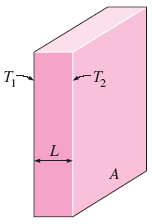
The heat transfer from one surface (at a temperature T1) to the other surface (at T2) can be expressed as: q=Sk(T1-T2) where k is the thermal conductivity of the solid and S is the conduction shape factor.
Example: Shape factor refers to a value that is affected by an object's shape but is independent of its dimensions.
es: Factor de forma de conducción
Convection resistance
noun
Thermal Convective Resistance is always equal to inverse of the product of convective heat transfer coefficient and surface area.
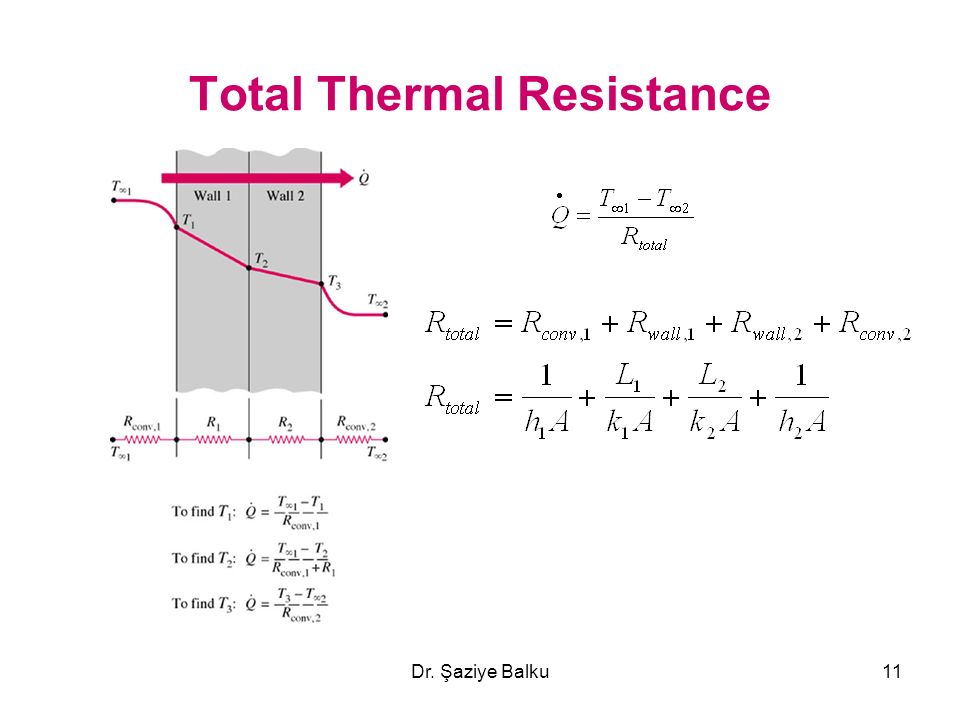
Example: Heat flow through a two layer wall . The rate of heat flow will equal the total temperature difference divided by the sum of the thermal resistances (since the three thermal resistances are in series).
es: Resistencia a la convección
Critical radius of insulation
noun
The critical radius of insulation is a counterintuitive concept within the study of heat transfer. The theory states that adding insulation to a cylindrical or spherical object will increase the rate of heat loss rather than decrease it, if the radius (thickness) of the insulation is at its “critical” value.
Example: Maximum heat loss with min thermal resistance. This concept is useful in the situation when surface area of the base object increases with the insulation, i.e., cylindrical and spherical systems.
es: Radio crítico de aislamiento
Cylinder conduction resistance
noun
Thermal resistance is a heat property and a measurement of a temperature difference by which an object or material resists a heat flow.
Example: Heat loss through pipe walls, heat transfer in double-pipe or shell-and-tube heat exchangers
es: Resistencia de conducción del cilindro
Efficiency
noun
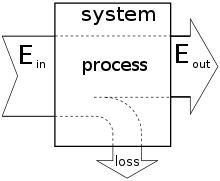
Efficiency is one of the most frequently used terms to indicate how well energy is converted into useful work. Generally it is defined as the ratio of desired output to required input. Energy efficiency (i.e. ratio of output energy to input energy) is primarily based on the 1st law of thermodynamics.
Example: In the middle of twentieth century, a typical steam locomotive had a thermal efficiency of about 6%.
es: Eficiencia
Fin effectiveness
noun
The effectiveness of the fin is the dimensionless parameter which can be measured the ratio of the heat transfer from the fin to the heat transfer occupied by the fin without fin attached.
Example: The ratio of the actual heat transfer rate through the fin base divided by the maximum possible heat transfer rate through the fin base, which can be obtained if the entire fin is at base temperature (i.e., its material thermal conductivity is infinite).
es: Eficacia de la aleta
Fin efficiency
noun
Fin efficiency is defined as the ratio of actual heat flow of the fin to that which would be obtained with a fin of constant temperature uniformly equal to the base surface temperature, that is, one with infinite thermal conductivity.
Example: The fin efficiency is defined as the ratio of the heat transfer to the fin to the heat transfer to an ideal fin.
es: Eficiencia de las aletas
Interface resistance
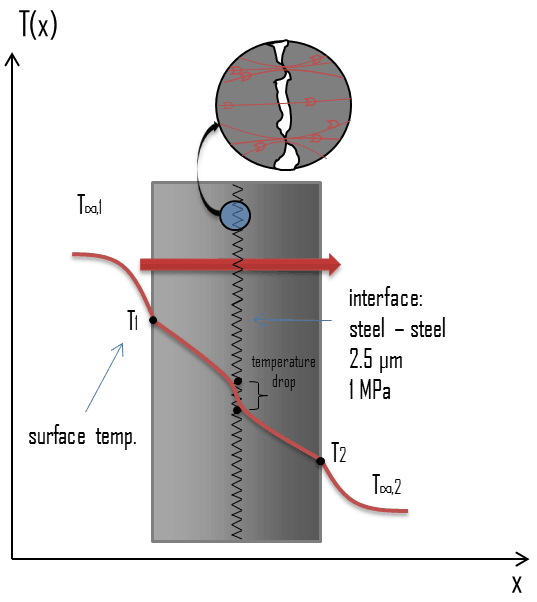
Interface's resistance to thermal flow. This thermal resistance differs from contact resistance because it exists even at atomically perfect interfaces. Owing to differences in electronic and vibrational properties in different materials, when an energy carrier (phonon or electron, depending on the material) attempts to traverse the interface, it will scatter at the interface.
Example: Assuming a constant thermal flux is applied across an interface, this interfacial thermal resistance will lead to a finite temperature discontinuity at the interface.
es: Resistencia de interfaz
Plane wall conduction resistance
noun
Is the thermal resistance of the wall against heat conduction or simply the conduction resistance of the wall.
Example: Temperature Distribution Through a Plane Wall. For one-dimensional conduction in a plane wall, temperature is a function of the x coordinate only and heat is transferred exlucively in this direction.
es: Resistencia a la conducción de la pared plana
Radiation resistance
noun
The radiation resistance can be defined as the value of resistance that would dissipate the same amount of power as radiated as radio waves by the antenna with the antenna input current passing through it.
Example: In radio transmission, a radio transmitter is connected to an antenna. The transmitter generates a radio frequency alternating current which is applied to the antenna, and the antenna radiates the energy in the alternating current as radio waves. Because the antenna is absorbing the energy it is radiating from the transmitter, the antenna's input terminals present a resistance to the current from the transmitter.
es: Resistencia a la radiación
Sphere conduction resistance
noun
Spherical and cylindrical systems may be treated as one dimensional, due to the temperature gradients in the radial direction.
Example: Consider heat conduction through a hollow sphere of inner radius and outer radius, made of a material of constant thermal conductivity
es: Resistencia a la conducción de la esfera
Surfaces
noun
A surface, as the term is most generally used, is the outermost or uppermost layer of a physical object or space. It is the portion or region of the object that can first be perceived by an observer using the senses of sight and touch, and is the portion with which other materials first interact.
Example: Thermodynamic surfaces are three-dimensional diagrams that describe every equilibrium point of a pure substance, including the vapor, liquid, and solid phases.
es: Superficies
Thermal contact conductance
noun
Thermal contact conductance is the study of heat conduction between solid bodies in thermal contact. The thermal contact conductance coefficient, is a property indicating the thermal conductivity, or ability to conduct heat, between two bodies in contact.
Example: Materials with high thermal conductivity are used in heat sinks whereas materials with low values are used as thermal insulator
es: Conductancia de contacto térmico
Thermal contact resistance
noun
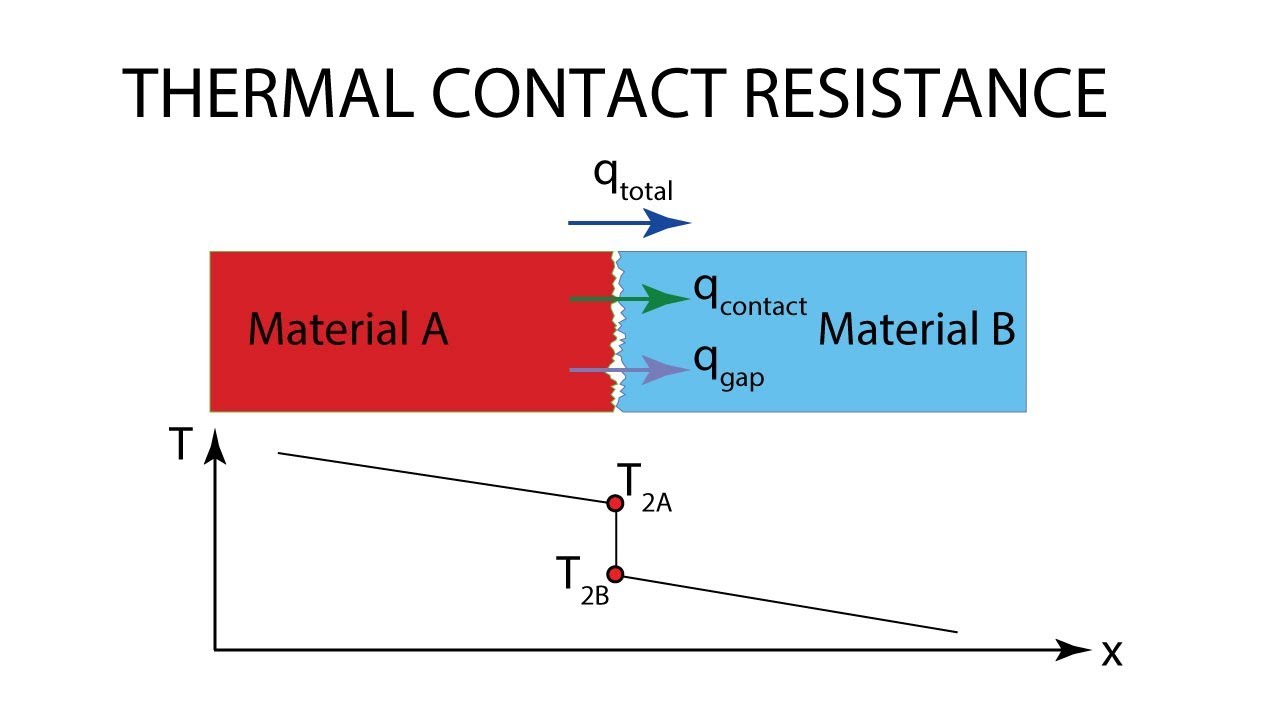
Thermal contact resistance is defined as the ratio between this temperature drop and the average heat flow across the interface.
Example: The thermal contact resistance can be minimized by applying a thermally conducting liquid called a thermal grease such as CPU grease on the surfaces before they are pressed against each other.
es: Resistencia al contacto térmico
Total thermal resistance
noun
Thermal resistance is a heat property and a measurement of a temperature difference by which an object or material resists a heat flow.
Example: Suppose that we want to calculate the heat flow through a wall composed of three different materials, and we know the surface temperatures at each outside surface, and the material properties and geometries. If the materials are homogeneous, the thermal resistance will represent the relationship between the thickness and the thermal conductivity of the material.